
Veranstaltungen 2022
Authors‘ Workshop “Video Conferencing. Practices, Politics, Aesthetics”
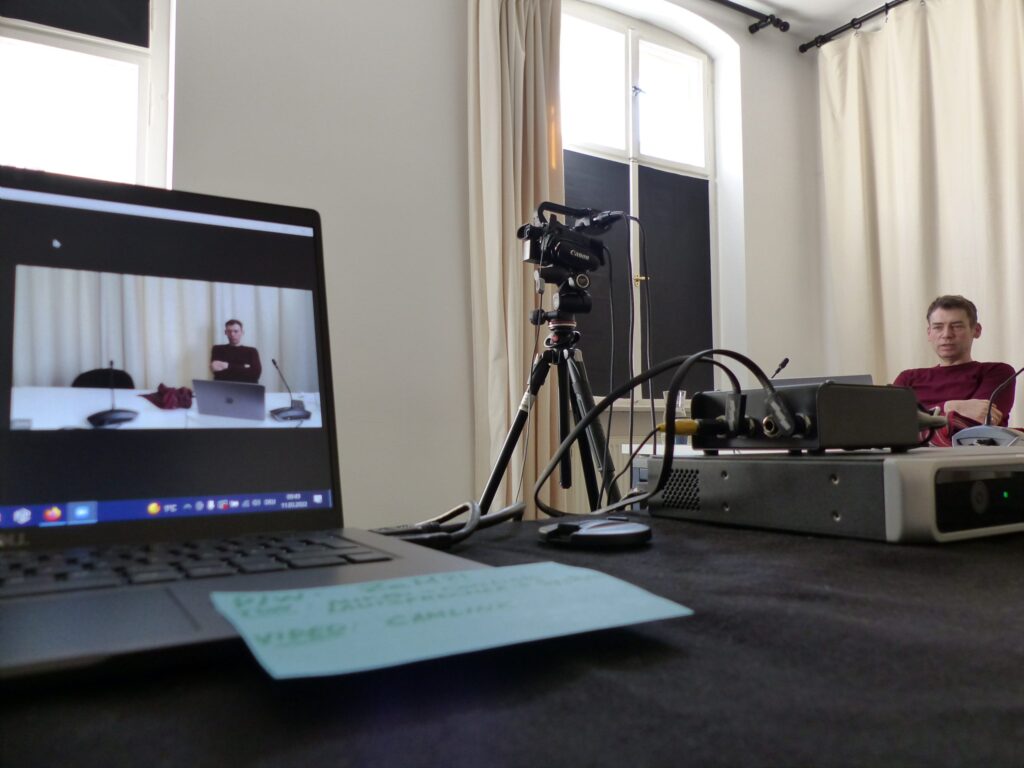
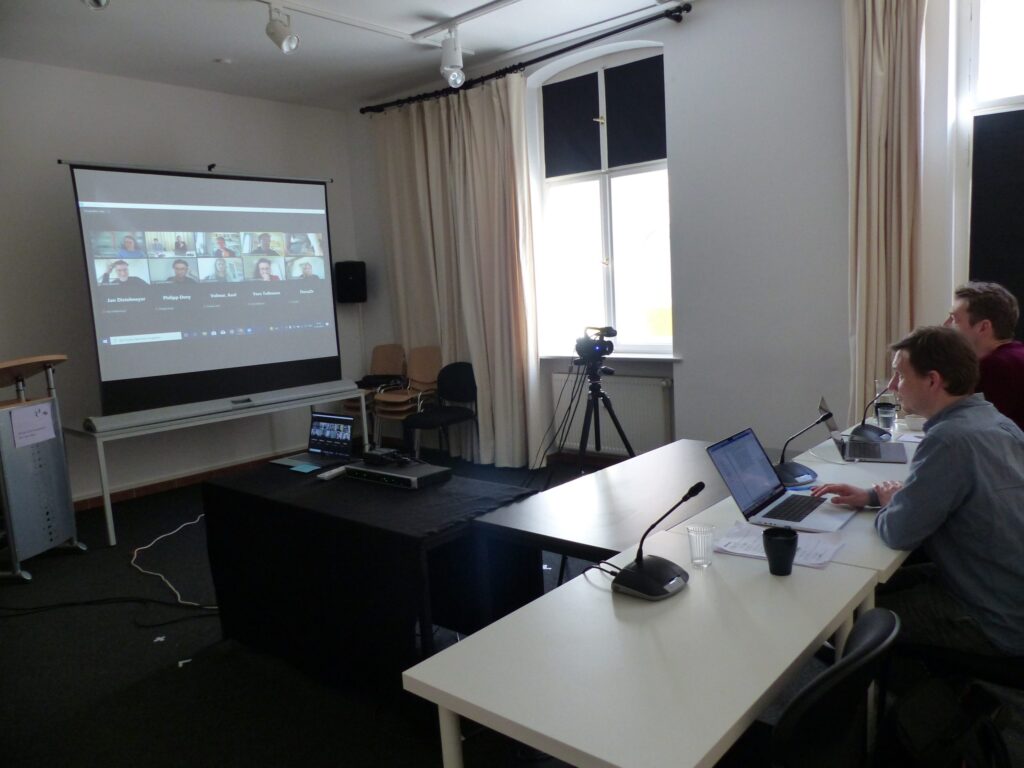
Author’s workshop for an international anthology edited by Axel Volmar, Olga Moskatova, and Jan Distelmeyer.
In cooperation with the Special Collaborative Research Center (CRC) 1187 “Media of Cooperation” at the University of Siegen.
The COVID-19 pandemic has reorganized existing methods of exchange, transforming comparatively marginal technologies into the new normal. Video conferencing in particular has become a favored means for spatially distributed forms of communication and collaboration without physical copresence. Corresponding apps and their infrastructures proliferate, leading to a widespread adoption of video conferencing in various societal domains, such as work, education, leisure, friends and family. This sudden omnipresence of video conferencing has already provoked a burst of reactions in recent months, with the rise of Zoom coming to stand for new practices of networked, synchronous online sociality. Scholars have discussed, for instance, Zoom’s physical effects (e.g., “zoom fatigue”), privacy issues, malicious practices (e.g., “zoom bombing”), and split-screen aesthetics. Despite this attention, however, video conferencing remains relatively understudied in media studies. The “Video Conferencing: Practices, Politics, Aesthetics” anthology therefore takes the current situation as a point of departure for examining the mediality of video conferencing, while expanding the scope of the examination beyond the context of the pandemic to address video conferencing as a medium more broadly.
Video conferencing establishes connections and mediations whose analysis requires the consideration of different levels and their interrelation. Its mediality prompts to interrogate the complex interplay of materiality and software, platform structures and economies, education and society, and the aesthetics of encounters and their associated practices and technical procedures. The focus on the conditions, procedures, and effects of mediation raises questions both technical and cultural, political and aesthetic, and historical and topical. What socio-technical and practical needs does video conferencing respond to, and which practices and conditions, conversely, are produced by video conferencing in the first place? What political, socioeconomic, and cultural contexts are operative or altered in the process? To what extent are new opportunities of access, participation, and spanning distances opened up, or the conditions of being-with narrowed? And finally, what aesthetic forms are being generated, passed on, or modified?
Uni Siegen:
The COVID-19 pandemic has reorganized existing methods of exchange, transforming the comparatively marginal technology of video conferencing into the new normal. Multipoint video conferencing in particular has become a favored means for web-based forms of remote communication and collaboration without physical copresence. Taking the recent mainstreaming of video conferencing as its point of departure, the authors workshop examines the complex mediality of this new form of social interaction and cooperation. Connecting theoretical reflection with material case studies, the contributions questions practices, politics and aesthetics of videoconferencing and the specific meanings it acquires in different historical, cultural and social contexts.
Organizers: Axel Volmar, Olga Moskatova, and Jan Distelmeyer